Where this project has been , and where it’s going
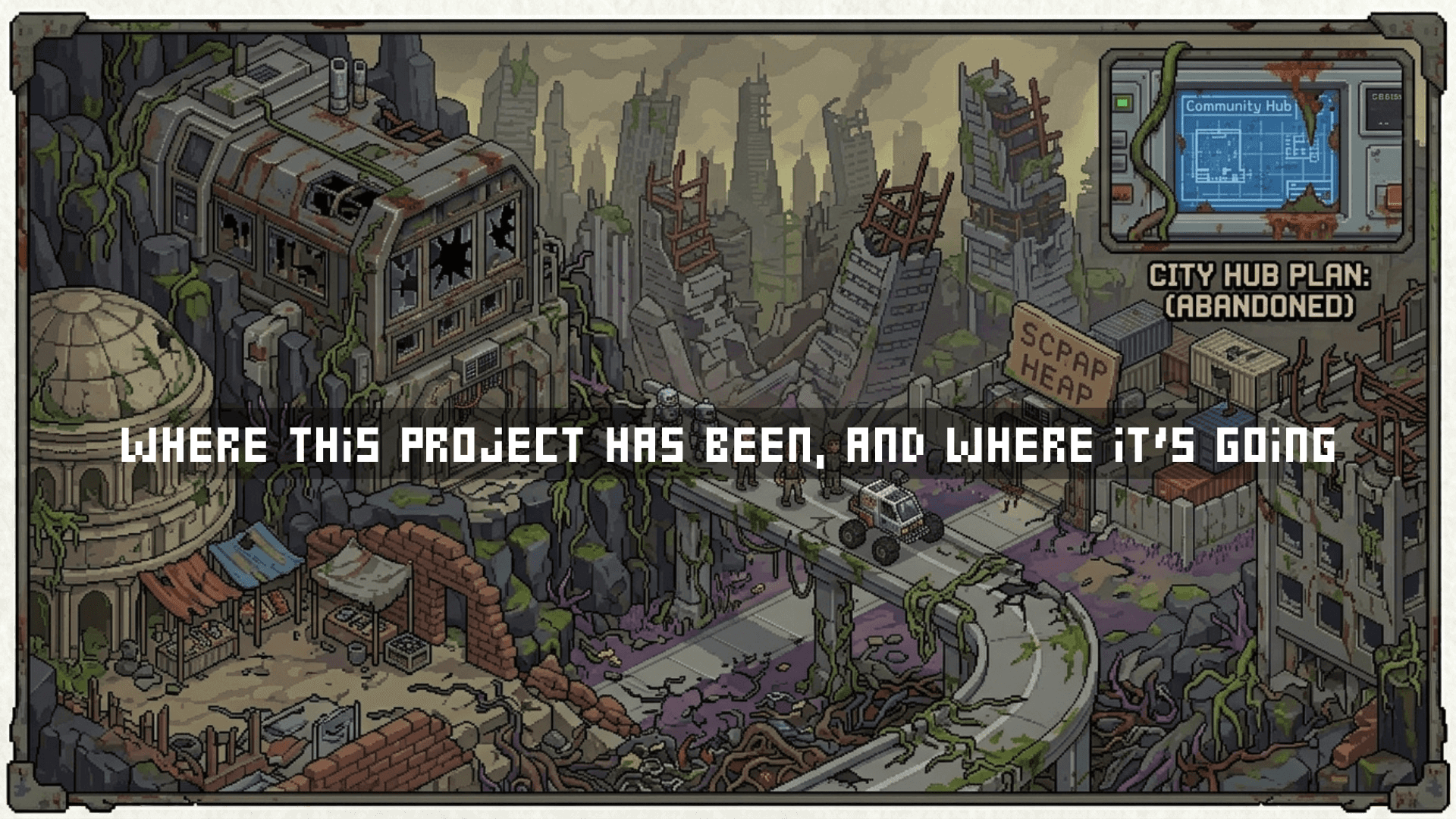
I’m a few posts into sharing this project, and it feels like the right moment to stop and take stock to lay out the whole path so far in one place, and be honest about what’s actually left. Partly for anyone following along, and partly for me, because seeing the timeline written down is how I keep from getting lost in it.
It started in a notebook. Before any of this was a game, it was a research question I couldn’t get right six versions, crossed out one after another, until the real one was left. The short version: I wanted to understand how a game could make two people build meaning together, through what they see and say, without leaning on traditional storytelling. That question is still the engine of everything.
Then it found a world. I set the game inside the world of a novel I’m writing — a ruined, post-catastrophe future placed in a gap the novel never dramatises, so I’m anchored but free. One imagination, two forms.
Then it found its shape. Two survivors, separated, who can only escape by talking across the gap between them. That core, two people, one world, seen and solved differently is the thing every other decision hangs off.
Then it went through a lot of honest revision. The story got warmer (I almost built something clever but cold, and changed course). The scope got smaller (I cut a whole survival-game’s worth of features down to a focused core, because the number one way a student game fails is never getting finished). The mechanic got cleaner (two interlocked puzzles instead of one fiddly split view). And I solved how a game with no text teaches the player through shape, light, and, crucially, the other player talking. Almost every change did the same two things: made it warmer, made it smaller.
Where I am right now. The design is, honestly, done the whole game is on paper: story, levels, mechanics, the visual language, the escape journey from a sealed dark bunker out into daylight. That’s a strange and slightly uncomfortable place to be, because design is the fun part, and now the real work starts: actually building it.
Where it’s going. Here’s the road ahead, roughly in order:
The tools I am learning for pixel art its Aseprite, and the two-camera split-screen setup in Unity that makes the whole “two players see differently” idea work.
Build the core interaction, one small cooperative puzzle that genuinely can’t be solved alone and test it with two real people. That’s the make-or-break moment; if that works, the whole idea is proven.
Build the first three levels the bunker escape which is the complete, finishable heart of the project. From paper to digital
Run a small study with real pairs playing it, to actually see how the communication and shared understanding play out. (This part comes with its own gate ethics approval which I need to sort early.)
Write it all up, and let the survival-world “outside” section be a stretch goal if there’s time.
The honest bit. I’ve spent a long, happy stretch designing, and design can quietly become a way to avoid the scarier thing: opening the engine and finding out whether I can actually build it. So this checkpoint is also a line in the sand. The next post won’t be about planning. It’ll be about doing starting with learning to make a single pixel-art tile, and getting two cameras to show two different views of one room.
If there’s one thing this timeline taught me, it’s that the project didn’t get better in big dramatic leaps. It got better in a lot of small, honest corrections each one making it a little warmer, a little smaller, a little more real. I think the building will be the same. One small thing at a time.