Building a game inside the world of my own novel

There’s a decision I made early that I keep being glad about: my game is set inside the world of a novel I’m writing.
The novel is a quiet post-catastrophe story, a ruined future, a war that emptied the Earth, the survivors who could leave living somewhere else, and the ground below turned into a kind of forbidden archive. When it came time to choose a world for the game, I had a choice. Invent something fresh, or build inside the world I already had.
I chose the novel’s world, and not just for sentimental reasons. There’s a real design logic to it.
The obvious risk with using your own established fiction is that it boxes you in and you can’t contradict what’s already written. But I found the opposite. The novel’s main events happen at a specific moment in its timeline. If I set the game in a gap the novel never dramatises, a stretch of years it skips over, then I’m anchored and free. Anchored, because it’s canonically the same world, same rules, same texture. Free, because nothing I do there can contradict the book; the book simply isn’t looking at that moment.
So that’s where the game lives: a generation after the fall, in the ruins, grounded in a recognisable place. Same drowned, overgrown, rusted world as the novel but a corner of it I get to invent from scratch.
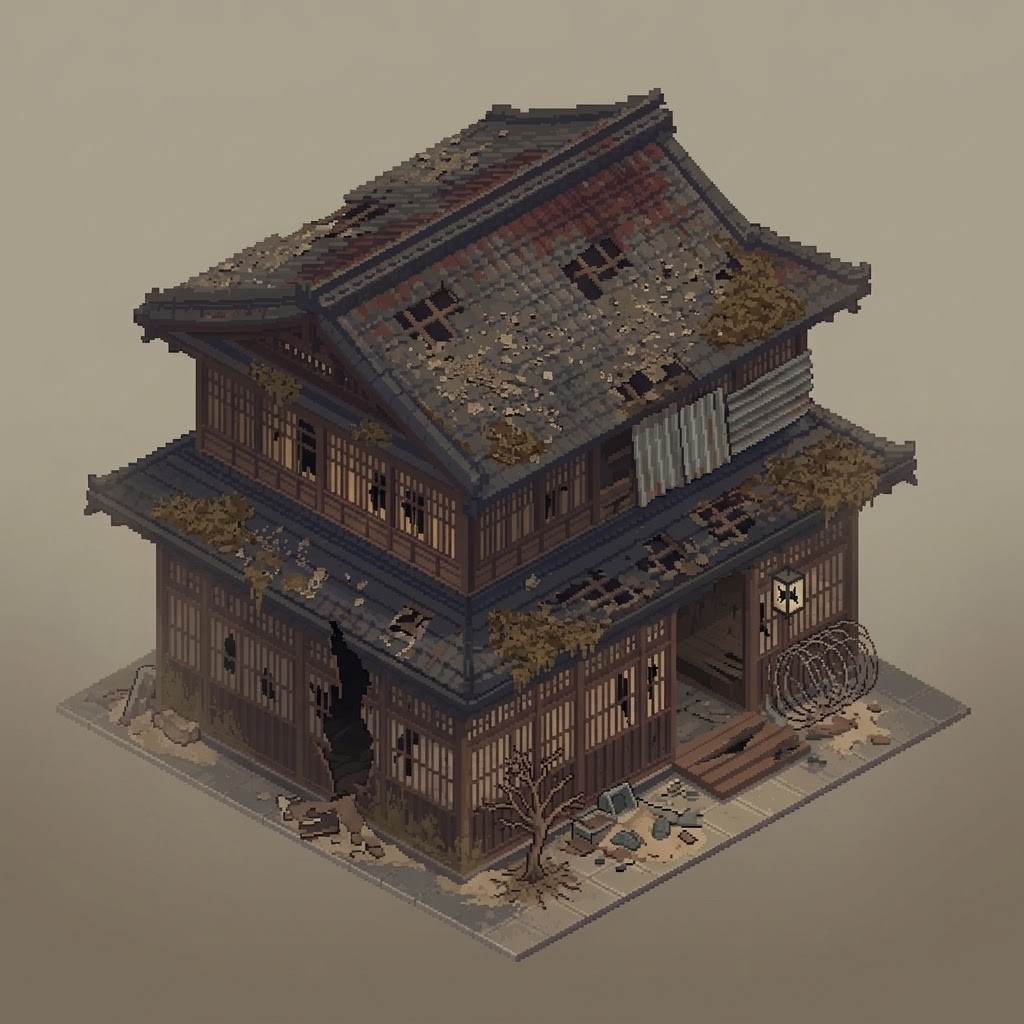
The part I didn’t expect is how much this helps rather than constrains. When I need to know what a room feels like, or what technology exists, or how light falls in this world, I don’t have to invent from nothing the novel already answered. The world has a consistent grammar because it’s the same grammar I’ve been writing in prose. A machiya house half-swallowed by vines, a warm lamp in a cold ruin those aren’t arbitrary art choices, they’re already canon.
And there’s a thesis reason too, which I only half-realised at first. My degree is about creative practice, and one thing that makes practice strong is coherence: evidence that you’re one practitioner with a consistent vision, not someone stitching unrelated things together. A game and a novel that share a world is exactly that: one imagination, working across two forms. That’s not a coincidence I have to explain away. It’s a strength I can point to.
The honest tension is that a novel is a dark story, and I want the game to be warm, something people, even kids, can enjoy. But I’ve found the world holds both. The dark history sits underneath, as texture for anyone who looks closely, while the surface of the game is about something hopeful: two people helping each other get out. Same world, different emotional register. More on that in a later post, because deciding to warm it up was one of the biggest turns this project took.
What I learned here: using your own world isn’t a shortcut, but it is a foundation. It gives every art and design decision a place to stand, and it makes the whole project feel like one thing instead of three.