It started in a notebook: six versions of one question

Every project has an origin story, and mine is embarrassingly ordinary: a cheap notebook, a green pen, and a question I couldn’t get right.
I’m doing a Master’s where the thesis isn’t only a written document; it’s a thing you build. A game, in my case. But before any of that, you need a research question, and I genuinely thought that part would be quick. Pick a topic, write a sentence, move on. Instead, I filled pages crossing my own ideas out.
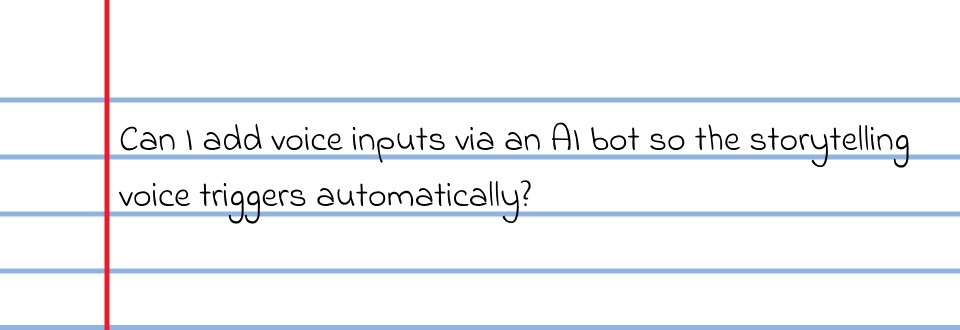
The first version isn’t even a research question. It’s me wondering whether I could bolt AI voice narration onto a game so the storytelling would trigger automatically. I wrote it down, sat with it, and quietly killed it; it wasn’t really a research idea, it was a feature, and a shaky one. But underneath it was something I kept circling back to: could a game make you feel something through visual language and interaction alone, without leaning on traditional storytelling?
That question survived. Everything after it was me sharpening the same blade.
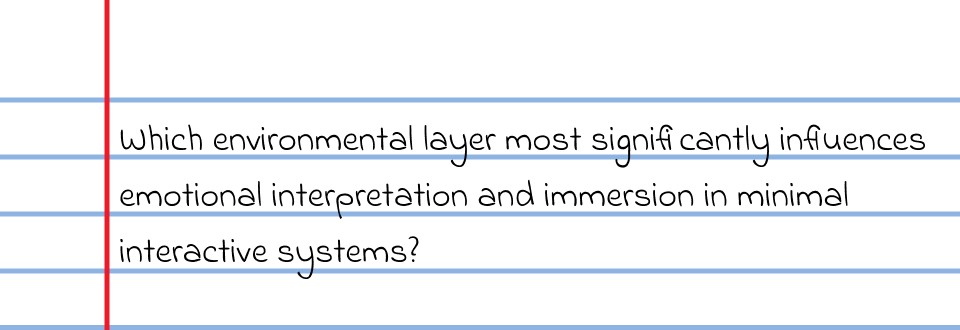
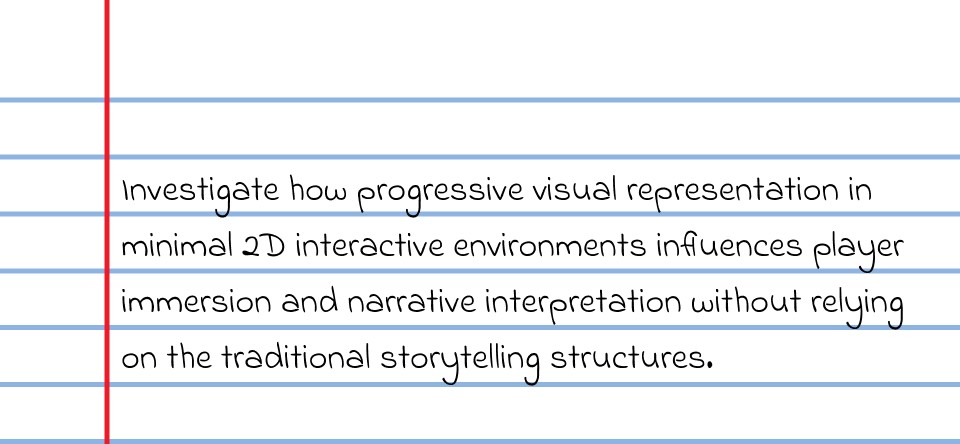
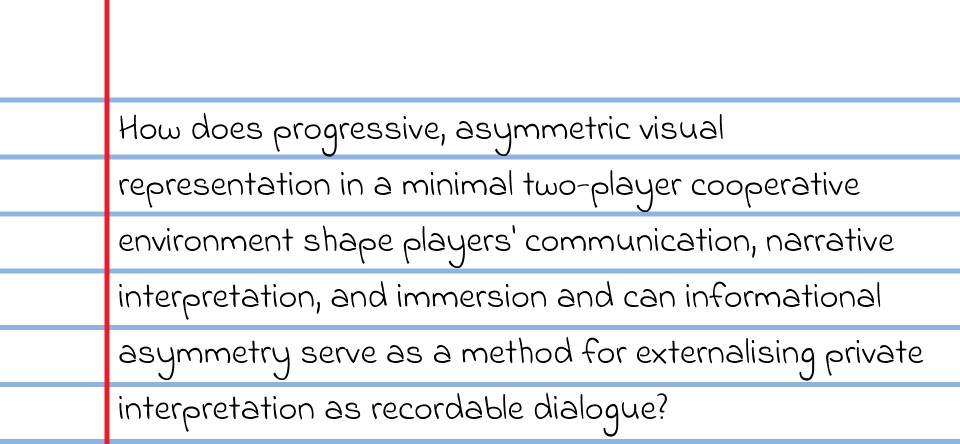
The next version got obsessed with “layers”: colour, animation, movement, motion design and which of them actually move a player emotionally in a minimal game. Then it tightened again into something almost academic: how does progressive visual representation in a small 2D interactive space shape immersion and how someone interprets a story, without conventional storytelling holding their hand?
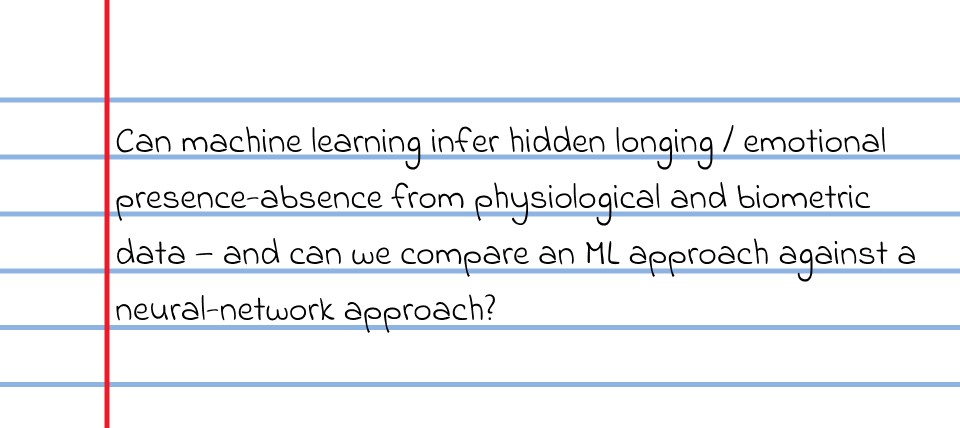
I took one detour I’m glad I can point to now. For a while I wondered whether machine learning could infer someone’s hidden emotional state from biometric data like heart rate and physiological signals. It’s a fascinating question. It’s also a completely different, much heavier thesis, and it pulled away from the thing I actually cared about: how people make meaning together. So I parked it. Writing down the road you didn’t take is worth something it shows the choice was deliberate.
By the last page, six versions in, it had resolved into a diagram instead of a sentence: two players, seeing a world differently, feeding into a cooperative game, driving toward a moment where their two views converge and branching into a study and a public installation.
Here’s what I actually learned, and it’s the reason I’m starting the blog here: the question was found, not planned. I didn’t sit down and author it. I circled it six times, crossing out the near-misses until the real one was left. For a while I felt behind because I hadn’t “just known” my topic. Now I think the crossing-out was the work.
So this is the beginning. A notebook, a question that took six tries, and a diagram that turned out to be the whole game.